

A butterfly release is widely regarded as a meaningful ceremonial element for commemorating a wedding, honoring a memorial, or marking a significant life milestone. The visual impact of butterflies taking flight can be extraordinary; however, the process requires careful planning. Because live insects are being handled, planners must approach the event with attention to environmental conditions, timing, and ethical treatment.
This guide provides a comprehensive overview of the butterfly release process, from selecting the appropriate packaging and quantity to the critical acclimation protocols required for a safe and ethical release.
What does a Butterfly Release involve?
A live butterfly release is an orchestrated event in which participants release bred butterflies into a designated outdoor location. The whole process starts long before the actual moment of the release. Butterflies are kept in a cool environment so that they can stay in a dormant state. Then the butterflies are thermally liberated before being released.
Guests are either handed individual envelopes or in group releases; this can be done via a collective release container. Once butterflies are released, they will usually fly towards the flowers or the lights, then disperse. In most releases, the experience is described as very quiet, almost ceremonial, and lacking a loud, exuberant atmosphere.
Most In-Demand Butterfly For Release: Painted Lady (Vanessa Cardui)
The most frequently utilized species for commercial releases in North America and Europe is the Painted Lady (Vanessa cardui).
- What they look like: The butterflies are easily identified with orange and black patterned wings with white spots on the tips of the forewings.
- Why they are used: Painted Ladies are used for being hardy and widespread. They are native to almost all of the continents (except Antarctica and South America), and therefore present minimal ecological risks when used.
- Behavior: They are active during the day and are heliophilic (sun-loving), which makes them suited for daytime activities. Their flying movements are quite erratic, with a tendency to fly upwards, which creates a spectacular experience.
- Logistics: These species are better than the larger and more fragile butterflies at surviving shipping and refrigeration. The butterflies’ smaller wing area and the associated lower metabolic demand reduce their stress, physical injury, and thermal shock susceptibility, which increases their shipping survival.
Choose Your Butterfly Release Format
The method of release and grouping of the participants will have a significant impact on the visual effect. The event planner must decide between individualized interaction and collective participation.
Individual Guest Release
In this method, each guest receives an organizational, butterfly envelope, glass, or paper that allows transportation of the butterfly without damaging the wings. Guests receive an envelope and open it simultaneously or in waves. This method fosters a high level of personal connection, as the butterfly often crawls onto the guest’s hand before taking flight. It requires logistical coordination to distribute envelopes efficiently.
Mass Group Release
In a mass release, butterflies are housed inside a decorative box or cage placed at the event’s focal point. When opened, the insects emerge together in a concentrated wave, forming an immediate burst of color and motion. Planners often pair this method with a defining cue, such as a first kiss, closing prayer, or final tribute. Guest involvement is minimal, which simplifies logistics and reduces handling risk.
Combination Release
For maximum impact, some events use a coordinated hybrid method. Designated participants, such as the couple, honorees, or immediate family, open a central mass release box positioned at the visual focal point, while guests stationed along the perimeter open individual envelopes on cue. This creates a dense, camera-ready lift at center stage with secondary flights expanding outward, producing movement, depth, and symmetry.
Package and Presentation Options
The containment method is not merely aesthetic; it serves as the temporary habitat for the butterflies during the acclimation phase.
Envelope Release Package Options
The basic design of envelopes typically includes some form of ventilation, and this serves the butterflies’ release needs. Standard envelopes used for butterfly releases are typically available in wholesale white/ivory colors; however, for personalized releases, some companies offer printing and color options, as well as padding that corresponds to the release date, names, and other text. Depending on the ambient temperature, they can also be handed out by ushers before the release, or placed on chairs, and, in some cases, will be used as standing release envelopes
Box Release Package Options
The release boxes used for the group butterfly releases are designed to allow maximum ventilation for the butterflies.
- Standard Mass Release Box: Simple design, with a lid that can be completely removed.
- Medium Release Box: Ideal for small quantities, typically 12-24 butterflies.
- Heart Box: Primarily used for weddings and romantic events, it is a popular choice.
- Divided Box: A box that includes separators, allowing the release to be divided (e.g., the bride releases one side and the groom releases the other).
- Color Coordination: Ribbons and box materials are often customizable to align with event themes.
Choosing the Right Quantity
Determining the number of butterflies requires balancing budget, visual impact, and logistical capacity.
Guest-Count Method for Envelopes
In individual releases, the simplest calculation method is the 1:1 method. However, it is a good idea to order 5-10% more. This covers any errors made by guests when handling the envelopes.
Moment-Design Method for Box Releases
For mass releases, the quantity is determined by the desired visual density.
- Intimate gatherings: 12- 24 butterflies will be sufficient.
- Large crowds: 50+ butterflies will be necessary for the release to be seen from afar.
| Pro Tip: Always plan for a little more to achieve a swarm effect, especially if a couple of butterflies remain in the box. |
Event Planning by Purpose
Each type of event has its own guidelines regarding butterfly releases, and as such, we have developed sample protocols for common events.
Wedding Butterfly Releases
- Recommended Format: Hybrid (mass box for couple and individual envelopes for wedding party)
- Timing: Immediately after the “I do’s” or during the recessional
- Logistics: While the couple takes their photos, ushers can distribute
- What not to do: Releases done too late in the evening. The butterfly releases will not be able to take flight until the sun has warmed them.
Funeral Butterfly Releases
- Recommended Format: Individual envelopes
- Timing: At the grave site committal or at the end of the outdoor memorial service
- Logistics: The envelopes will be located in a basket at the registration table for guests to take
- What not to do: Forced participation. Some guests may not be comfortable touching bugs, and should be given the choice to participate
Memorial and Celebration of Life
- Recommended Format: Mass release box
- Timing: During a moment of silence or a designated song
- Logistics: The box should be placed on a table by the photo memorial
- What not to do: If the box is left in the sun for too long, the butterflies will become too active and will damage their wings before the release.
Graduation Releases
- Recommended Format: Mass release (symbolizing the class flying the nest).
- Timing: Right after the tassels are turned.
- Logistics: Class representatives take care of the boxes on stage.
- What not to do: Releasing indoors. Butterflies will fly toward skylights and become trapped.
Birthday Releases
- Recommended Format: Medium box (same as the age being celebrated).
- Timing: Prior to cake cutting (if it is an outdoor event) or as a separate garden activity.
- Logistics: The birthday child is responsible for the release.
- What not to do: Unsuitable handling by very young children without adult supervision, which can crush the butterflies.
Anniversary and milestone releases
- Recommended Format: Hybrid or mass release box, depending on guest involvement.
- Timing: At the conclusion of speeches, vow renewals, or recognition moments.
- Logistics: A coordinator or family representative presents the box to the honorees, while additional participants may receive envelopes distributed shortly beforehand. Confirm a clear outdoor release zone with minimal overhead obstructions and adequate sunlight.
- What not to do: Poor alignment with the program schedule. Extended delays can cool the butterflies, reducing flight performance and diminishing the visual impact
School and community event releases
- Recommended Format: Mass release box for stage presentation; optional limited envelopes for selected participants.
- Timing: At the finale of the ceremony, ribbon cutting, or dedication moment.
- Logistics: Designate trained staff or volunteers for transportation, setup, and crowd control. To minimize crowd jostling, set up a perimeter and instruct participants on soft, upward release. Ensure compliance with local wildlife regulations and appropriate species.
- What not to do: large, unstructured crowds. Mayhem, large crowds, and mishandling of butterflies pose risks of injury to butterflies and safety.
Delivery, Timing, and Pre-Event Handling
The biological needs of the butterfly dictate the logistics of delivery and storage.
Delivery Timing
The shipping of the butterflies must occur the day before the event. This allows for the transport of butterflies to occur via the overnight shipping route to minimize stress. It should be noted that event planners must be on-site to receive the butterflies, preventing heat stress in transit and cold stress upon unloading on a porch.
Handling on Arrival and Storage
In the event that the shipping container arrives with an ice pack that is still frozen, no damage to the package should be left unattended, and no Individual envelopes or the mass release box should be opened.
- Refrigeration: The butterflies need to remain dormant during transport. Place the release container or envelopes in a standard refrigerator (not the freezer) at about 38°F – 50°F (3°C – 10°C).
- Avoid: Placing near the freezer vents (too cold) or in the vegetable crisper drawers (too warm & too humid).
Ethical Transportation and Responsible Handling
The welfare of the livestock is paramount. Reputable breeders adhere to strict ethical transport principles.
Ethical transport principles for live butterflies
Transporting live butterflies is conducted in accordance with rigorous ethical standards. Shipment containers are built to be warm and are equipped with ice packs to keep the butterflies in a state of hibernation. This will lower their metabolic rate, and they will not require food during the transport. It will also prevent them from damaging their wings by flying around within the container.
What buyers should do to support ethical transport outcomes?
- Prompt Retrieval: Make sure the package is not left in the mailroom
- Temperature Control: Keep the unit cool, as it is likely to become acclimated to the environment at the release location.
- Minimize Disturbances: Do not shake the box or envelopes.
Step-by-Step Butterfly Release Instructions
According to the North American Butterfly Association, responsible butterfly handling during events requires temperature control, minimal disturbance, and adherence to species-appropriate release protocols. To achieve a successful release, it is very important to keep to a specific timetable.
Step 1: Pick an outdoor location and verify conditions
Outdoor locations are required for butterfly releases because butterflies use polarized light for navigation.
- Temperature: Ideally above 65°F (18°C).
- Space: Choose an open space with minimal obstacles or nearby bird predators.
Step 2: Plan roles, guest instructions, and timing control
Designate one individual as the removal coordinator for the butterflies. Inform guests of the importance of not grabbing the butterfly by the wings, as they can be easily injured.
Step 3: Acclimate before release
This is the most critical biological step.
- Remove from Fridge: 1-2 hours prior to the release, remove the butterflies from the cold storage.
- Warm-Up: Butterflies will have their metabolism increased and they should begin to vibrate. Ensure the box is not in direct sunlight to prevent overheating, and do not cover the bottom with cardboard.
Step 4: How to release from envelopes
- Place the envelope flat onto your palm.
- Open the envelope flap.
- Tilt the envelope so the butterfly can crawl out.
- Do NOT shake the envelope to get the butterfly out. You should let the butterfly warm its wings.
Step 5: How to release from a box
- Place the box on a sturdy table or hold the box at your chest height.
- Open the box lid slowly.
- Some butterflies will fly out immediately, and some will need a gentle nudge to get to the edge of the box to fly.
Butterfly Release Timeline
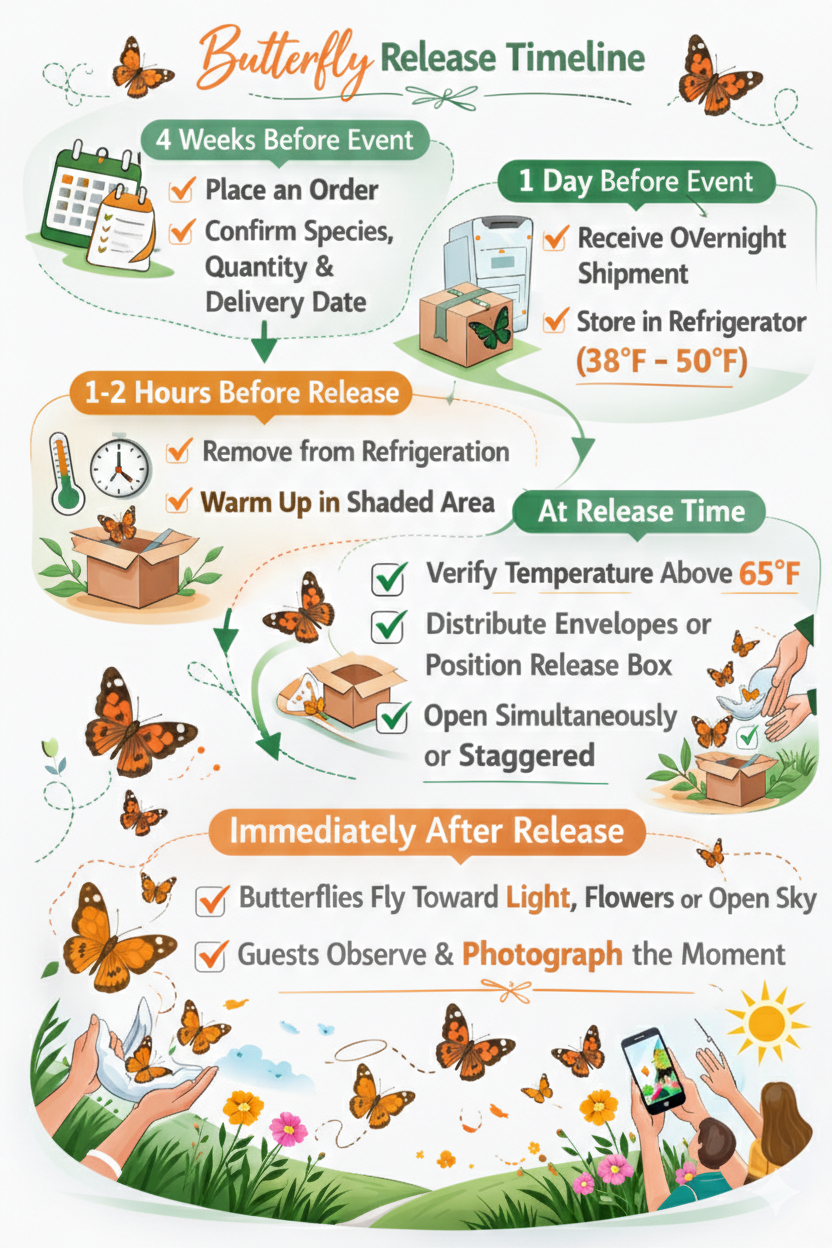
Safe Conditions and Responsible Release Planning
Weather-Based Contingency
If the temperature drops to 60° F (15° C) or below, or if it starts to rain heavily, we will need to postpone the release. It will not be possible to release butterflies during the rain, as it is harmful to the butterflies. In extreme weather conditions, postponing the release to the next day may be possible if the weather is better.
Responsible Release Guidelines
Release butterflies well before sunset so they have time to find food and shelter. According to the U.S. Fish and Wildlife Service, you should also verify that the species you’re releasing is not invasive to your local ecosystem. Painted Ladies are native to most regions, but always confirm with your supplier.
Conclusion
Now that you understand the butterfly release process, it’s clear how meaningful and visually impactful this ceremony can be. At Cloverlawn Butterflies, we have decades of experience in providing ethically hand-raised, healthy live butterflies for weddings, memorials, funerals, and other special events. As a family-run butterfly farm, we provide customizable release packages, dependable overnight shipping, and a 100% live arrival guarantee. We are determined to make your event as wonderful as possible.
FAQs
What is the difference between envelope releases and box releases?
Envelope releases are more personal, as they allow individual guests to take part by holding and releasing their own butterfly. Box releases are more of a singular spectacle, as a large group of butterflies is released from a single box to create a “cloud” effect.
Why are Painted Lady butterflies commonly used?
Because they are highly migratory and resilient, they are simple to breed and distribute without contact and disease, and their range extends to most of the areas that are within ecological concern for the distribution of potentially invasive species.
How many butterflies do I need for my event size?
If each guest is to release an individual butterfly, then you should purchase at least one butterfly for each guest and add an additional 5%. If it is a collective release, for mid-sized events, 24 to 50 butterflies are suggested to create a significant impact.
How far in advance should I schedule delivery?
It is recommended that orders be placed 3 to 4 weeks in advance. However, the delivery should be scheduled to arrive one day before the event.
Can guests release all at once or one group at a time?
Both are possible. A simultaneous release creates a dramatic photo opportunity, while a staggered release prolongs the experience.
What weather conditions should make us reschedule?
Heavy rain, strong winds (over 15 mph), or temperatures below 60°F (15°C) are unsafe for release.
What should I plan differently for early-week events?
Plan for a Friday delivery and ensure you have a secure, temperature-controlled environment to store them over the weekend until the Monday or Tuesday event.